


Getting your mule to trust you and catch him on your terms is something that every mule owner needs to master. Are you the herd leader? Are you the one they’re looking to for leadership? Are they looking to you to provide for them?
The answer to all the above should be yes.
In the video below I go over how to catch your mule on your terms – while in a stall.
But what about catching your mule on your terms when he is out at pasture?
Here is my very simple answer: You just about can’t catch a mule out in pasture.
When your animal is out in pasture, he has everything he needs. He doesn’t need you for food, he has all that “free feed” available. He doesn’t need you for water. He doesn’t need you for companionship. He has everything he needs – so why would he come to you?
Moving Your Mule Out of Pasture
Your mule needs to be pulled out of pasture and moved into a 20×20 stall. Why? Because that mule needs to be dependent upon you for everything. He needs to know that you are his provider and you are his herd leader.
Get that mule out of pasture and put him in that stall – and then leave him there.
Often we think of mules as dogs and want them to be “happy” – so we talk in high affirming voices, we give them treats and we love on them and show affection. Your mule is not a dog. That mule is not looking for affection and affirmation the way humans are accustomed to, and not even the way dogs are accustomed to. That mule wants leadership more than anything else.
By removing your mule from pasture and placing him in a 20×20 stall he will come to see you as the herd leader, and that leadership will bring him more joy than any feed ever would.
As a matter of fact, you are, in many ways, damaging and hurting your mule by leaving him out to pasture with all that feed. In my article, Mules Can’t Stand Prosperity, I talk more about this.
And let’s talk just a bit more about using treats. Do I use treats? Yes. There are two times when I will use treats from a distance to get them to reach to me. As soon as they figure out how to reach for it, then I will give it to them near their chest so they have to back up to get it. That’s it!
Treats often lead to the mule getting into your space – you don’t want them in your space. Remember, you are the herd leader and the herd leader says, “stay out of my space.”
Once Your Mule Is In The Pen
Once your mule is in the pen, you can’t just leave him there. You have to teach them and give them training. You see, the mule is not like a horse. The horse will get out there and just run – not the mule. The mule doesn’t see any sense in running. I will move them from the 20×20 pen into a round pen to teach that mule how to “catch me.” Notice that I use the phrase, “catch me.” You don’t want to be chasing down the animal.
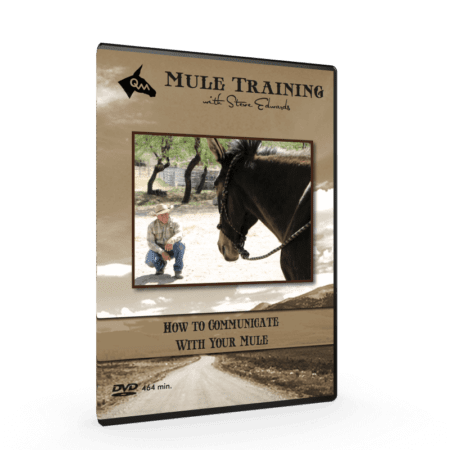
What does that look like? In the first of my instructional videos, How to Communicate with Your Mule, you see a woman with a mule that is hard to catch. By the end of the video, she is doing everything right and you see what catching should look like.
Can You Move Your Mule Back to Pasture?
In short, no. Don’t move your mule back to pasture because he can unlearn everything you worked on and go back to being dependent upon everything else but you.
Sure, it’s cheap feed and that’s a great way to save money, but folks, like I said above, you’re not saving money because you don’t know what’s in that feed. You don’t know how much they’re getting. You’ll see that all those carbohydrates can lead to grass founder and fat pockets. You end up killing that mule by leading them to the smorgasbord.
So what does your feeding program need to look like? You ought to check out this video I did all about feed. It is free, and very instructive on what a proper feeding program needs to look like. I talk about the feed I use, Lakin Lite, and why the pellet is the best feed out there.
A Bit More About Stalls
While this video is a bit off topic, it’s about two mules who are picking and biting at one another as sort of play, I talk a bit more about stalls and feed, and it would be good to check out.


4 thoughts on “Getting Your Mule to Trust You And Catching Them In Pasture”
I have a 4 month old mule colt that is halter broke. I am in the process of teaching him to lead . He is quickly learning the concept.
What is a good way to teach him to tie?
I have a 10 ye old John mule. He bucked me off once. Sent him to a reputable mule trainer. Has bucked several times with him, he didn’t come off. Previous owner was going to take him back but has changed her mind. History was first owner came off. 2nd owner said she has NEVER had a problem with him. I only had him a week when he thru me. Any hope for him??
I cant believe you’re trying to convince people hungry for knowledge that they should put their mule in a stall and not let them back out. You might have ways you go about things but that doesn’t make it right or helpful or good for the animal. There’s absolutely no reason in this day and age to have a mule other than for entertainment and keeping them locked up to get what you want from them fast is without question, literally exactly what psychos do because they don’t know how to have a genuine conversation and create a healthy relationship. Boxing your mule is NOT a respectable thing to do for a creature that desires to roam. You want to show your mule who is boss? We’ll get out on the trail and show him places he ain’t never seen before and feed him snacks he ain’t ever tasted before and be the person he has never met before.
Annabella Canady
Thanks for taking the time to read our article Annabelle. Encourage you to continue to do what works for you. Blessings.